The Hidden Accessibility Risk of Third-Party Tools in Website Redesigns
Why Third-Party Accessibility Tools Can Undermine Even the Best Intentions
When municipalities and public-serving organizations invest in a website redesign, accessibility is often front of mind. Leaders ask the right questions. Teams reference standards. Vendors confirm compliance.
And yet, months after launch, accessibility issues still surface.
The reason is rarely the website itself.
More often, the barriers appear inside the third-party accessibility tools connected to it.
Accessibility Is No Longer Just a Website Issue
Modern websites are not simply collections of pages. They are service platforms.
Residents use them to:
- Submit service requests
- Register for programs
- Book facilities
- Make payments or donations
- Access documents and maps
- Ask questions through chat tools
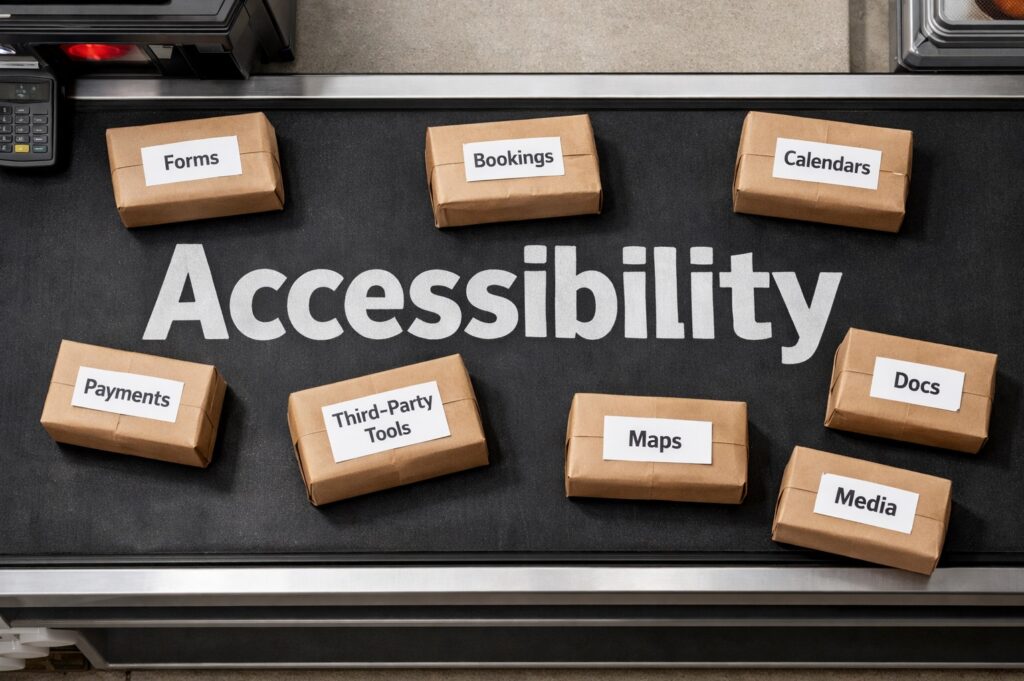
Many of these functions rely on third-party systems. Booking software. Form builders. Payment gateways. Mapping tools. Document viewers.
Even if the website itself is accessible, these tools can quietly reintroduce barriers.
From a resident’s perspective, the distinction does not matter. They experience one service, not a website plus a vendor tool.
From a compliance perspective, the responsibility remains with the organization delivering that service.
Where the Risk Really Comes From
Most accessibility challenges today do not come from visual design or page layout. They come from interaction.
Examples include:
- Forms that cannot be completed using a keyboard
- Error messages that are not announced by screen readers
- Booking systems that require complex visual cues
- Embedded maps or documents that cannot be navigated by assistive technology
These issues are often introduced by third-party tools that sit outside the core website.
Vendors may claim accessibility support. Some provide statements or documentation. But those claims are often limited, outdated, or incomplete.
Accessibility can also change over time. A vendor update can unintentionally introduce new barriers without notice.
Why Third-Party Vendor Accessibility Claims Fall Short
A common assumption is that accessibility responsibility shifts to the vendor when a third-party tool is used.
In practice, that protection is limited.
If a resident cannot complete a task on your website, the accountability still sits with your organization. Not the software provider.
This creates a gap between responsibility and control. Organizations are accountable for outcomes but may not have direct authority over how tools evolve.
Without clear oversight, accessibility risks can grow quietly after launch.
Accessibility Compliance Focuses on Services, Not Pages
Accessibility legislation focuses on removing barriers to access. It does not distinguish between content created internally and functionality delivered by vendors.
If a resident cannot submit a form, book a program, or complete a payment, the service itself is inaccessible.
This is why some organizations pass automated audits yet still receive complaints or support calls.
The issue is not whether individual pages meet technical criteria. It is whether people can complete real tasks without assistance.
A Shift in How Leading Organizations Are Responding
Forward-thinking municipalities and nonprofits are changing how they approach accessibility and third-party accessibility tools in three important ways.
First, accessibility is becoming a procurement requirement, not an afterthought. Vendors are expected to demonstrate how accessibility is tested, maintained, and fixed over time.
Second, organizations are testing full user journeys rather than isolated pages. This reveals issues that automated tools often miss.
Third, accessibility is being treated as an ongoing responsibility. Not a one-time project milestone.
This shift reduces risk and improves service quality at the same time.
What Municipal Leaders Should Ask About Third-Party Tools
You do not need to become an accessibility expert to lead effectively in this space. But a few strategic questions make a meaningful difference.
When selecting tools or approving redesigns, consider asking:
- Can residents complete critical services start to finish without barriers?
- Do our vendors actively test and maintain accessibility, or only claim it?
- Do we know how accessibility will be handled when tools are updated?
- Who is responsible internally for monitoring this after launch?
These questions move the conversation from compliance to service quality.
Accessibility as Digital Trust Infrastructure
Accessible digital services are not only about meeting legal obligations. They are about trust.
When residents can access services independently and confidently, it reinforces fairness, transparency, and inclusion.
When they cannot, it creates frustration, support burden, and reputational risk.
The most successful organizations recognize that accessibility lives between systems. Not just within pages.
A Better Question to Ask
Instead of asking:
Is our website accessible?
A more useful question is:
Can every resident use every service we offer online without barriers, regardless of who built the tool?
That shift in thinking is where real progress begins.
Categories
- Accessibility & Inclusive Design
- Awards, Media & Recognition
- Digital Governance & Risk
- Government & Civic Technology
- Hosting, Maintenance & Website Care
- Interactive Experiences & Digital Storytelling
- Museums, Heritage, & Art Organizations
- Pattern in Practice
- Research, Prototyping & Emerging Technology
- Websites, UX & Digital Platforms