Why Economic Development Websites Need to Build Investor Confidence
From Brochure to Decision Engine
Many economic development websites are built with the right intention.
They promote the community.
Showcase available land.
They highlight lifestyle, location, workforce, and opportunity.
But for investors, developers, and site selectors, promotion is only part of the picture.
The bigger question is this:
Can this community reduce uncertainty?
That is where many economic development websites fall short.
A modern investor-facing website should not behave like a digital brochure. It should behave like a decision-support tool. It should help someone quickly understand whether a community can support their project, what risks might slow them down, how quickly they can move, and who will help them navigate the process.
For small and rural municipalities, this shift matters.
Larger centres often have more staff, more visibility, and more established investment pipelines. Smaller communities may not be able to compete on scale. But they can compete on clarity.
And clarity builds confidence.
The investor attraction problem has changed
For years, economic development websites followed a familiar structure:
Community profile.
Key industries.
Available land or buildings.
Quality-of-life messaging.
Incentives.
Contact information.
None of that is wrong.
But it reflects an older model of investor attraction. It assumes the website’s main job is to make the community look appealing.
Today, location decisions are being made in a different environment.
The 2025 State of Site Selection report from the Site Selectors Guild and Development Counsellors International points to a decision landscape shaped by tariff volatility, power constraints, site scarcity, workforce challenges, and reputation risk. The report frames many of these pressures around risk, readiness, and reputation.
The 2026 Pulse Check builds on that picture. It captures input from 49 Guild members and looks at how location factors are shifting in a rapidly changing global landscape.
For municipalities, this means the website is no longer just a marketing channel.
It is often the first layer of due diligence.
An investor may never send an email or book a meeting if the website does not answer the right questions early enough.
Why Complete Economic Development Websites Still Fall Short
Many economic development websites look complete from the municipality’s point of view.
They have pages and they have photos. There’s pretty data a listing of land inventory.
They may even have a downloadable PDF.
The issue is not whether information exists.
The issue is whether the information helps someone make a decision.
A site selector or investor is usually trying to answer practical questions:
Can the site be serviced?
Is power available at the right capacity?
How long will approvals take?
Is there workforce depth within commuting range?
Are there infrastructure constraints?
Who coordinates the next step?
If the website only offers general statements, it creates friction.
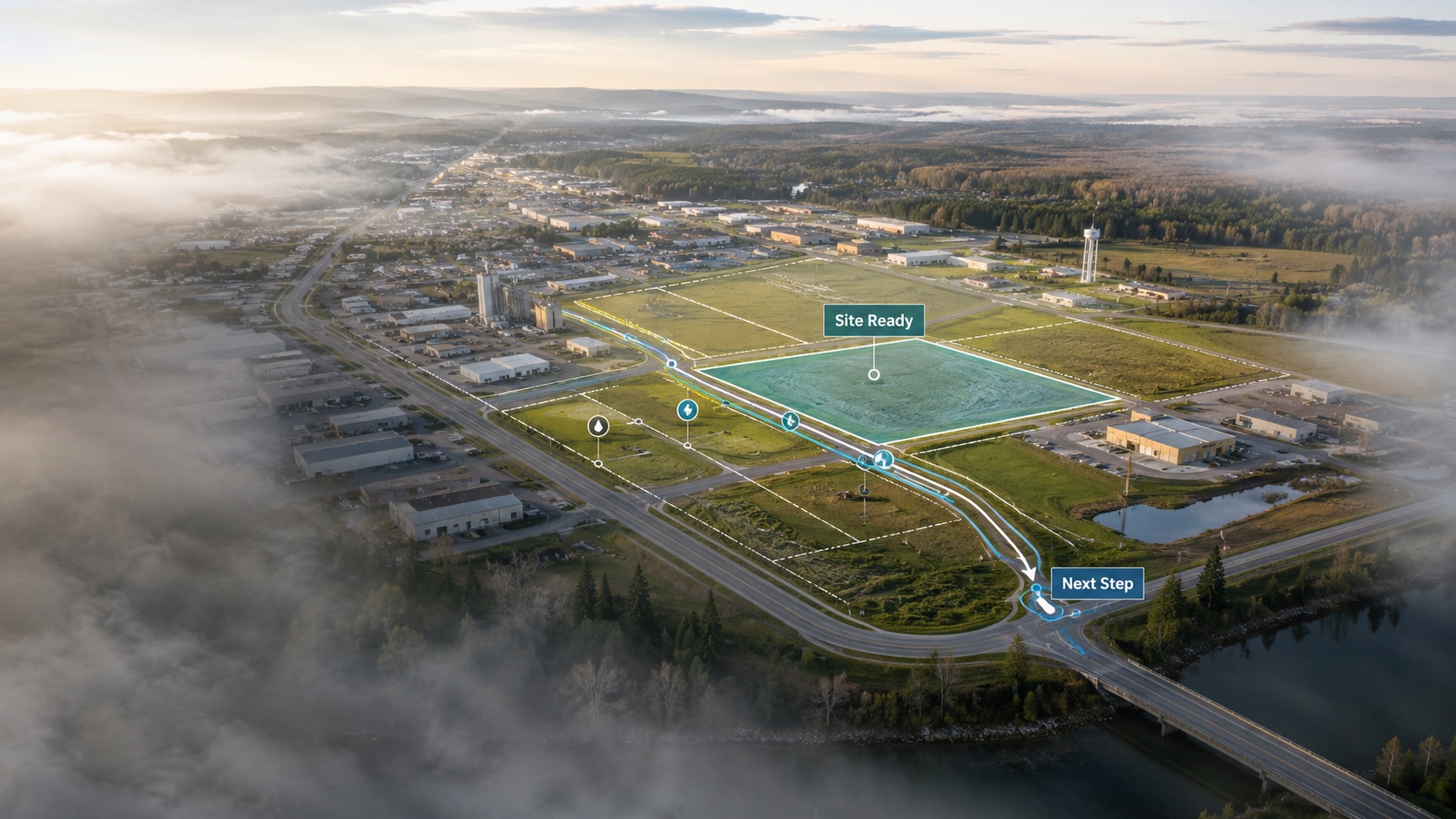
“Reliable infrastructure” is less useful than showing where serviced industrial land exists, what utilities are available, and what still needs to be confirmed.
“Skilled workforce” is less useful than showing labour force composition, nearby training institutions, commute-shed data, and sector-specific talent pipelines.
The Province of British Columbia’s land development toolkit makes a similar point. Site selection information goes beyond raw data. Communities should be prepared with site selector profiles, community profiles, and land inventories so they can respond quickly and professionally to investment inquiries.
That is the difference between a brochure and a decision engine.
A brochure says:
Here is why we are attractive.
A decision engine says:
Here is what you need to know to assess whether this project can work here.
Investors Are Looking for Operational Confidence
Site selection is practical.
It is not just about how a community presents itself. It is about whether the community can support a real operation.
A 2025 analysis from the University of North Carolina School of Government, summarizing Area Development survey data, shows how decision-focused these factors are. Site selection consultants rated skilled labour, available land, responsive state and local government, incentives, and energy availability among the most important location factors. Corporate executives placed strong emphasis on energy availability, quality of life, IT and broadband infrastructure, construction costs, and labour costs.
That tells us something important.
Investors do not separate “website content” from “community readiness.”
The way information is presented becomes a signal.
The community may appear unprepared with vague infrastructure data.
Or a municipality may appear slow, if permitting steps are unclear.
Outdated Land Listings, and the community may appear difficult to work with.
This does not mean every small municipality needs a complex enterprise platform.
It means every community needs to be intentional about the questions its website answers.
What decision-support looks like online
Some communities and regions are already moving in this direction.
The Alberta Site Selector Tool is a strong example of an investor-oriented digital experience. It allows businesses and investors to explore available properties, filter by property type, cost, and size, map proximity to highways, airports, railways, rail stations, and power, and view economic indicators such as population, labour force, and employment.
That matters because it reduces early-stage research friction.
The Town of Okotoks offers another useful example through its development permit activity and timeline page. The town explains that its statistics are provided for transparency and context, while also showing that development timelines are made up of several steps and can be influenced by multiple factors.
For investors, this type of transparency can build trust.
It shows that the municipality understands process visibility as part of economic readiness.
The best examples are not only about technology.
They represent a different philosophy.
The website is not just displaying information. It is helping the visitor evaluate momentum, readiness, and process.
The four layers of an investor confidence website
At Pattern Interactive, we believe the next generation of economic development websites should be built around four layers of investor confidence.
1. Operational support
This layer answers:
Can this community support my business?
It includes information such as serviced land, buildings, power, water, wastewater, broadband, transportation access, workforce data, sector strengths, and proximity to suppliers or training institutions.
The goal is not to overwhelm visitors with data.
The goal is to organize the right information so investors can assess fit quickly.
2. Risk mitigation
This layer answers:
What could slow this down or create uncertainty?
Investors know every location has constraints. What they want is visibility.
Useful content may include zoning clarity, environmental considerations, utility constraints, development fees, tax information, floodplain information, infrastructure plans, and links to relevant bylaws.
Risk transparency does not weaken a community’s position.
Done well, it builds trust.
3. Speed to market
This layer answers:
How quickly can we move?
Speed is now a competitive advantage.
BDO’s 2026 site selection analysis notes that businesses are under pressure to build quickly, but permitting, environmental reviews, zoning approvals, land-use entitlements, infrastructure requirements, and community review processes can extend timelines. It also notes that anticipating timelines can help avoid delays.
For an economic development website, this means investors should be able to understand approval steps, expected timelines, required documents, key contacts, and which sites are closer to development readiness.
Even a simple “How development works here” page can reduce confusion.
4. The human navigator
This layer answers:
Who helps us get this done?
Investors rarely want to navigate municipal departments alone.
They want a clear point of contact who can coordinate next steps.
This is where small communities can compete well.
Larger centres may have more resources. Smaller municipalities can often offer more direct access, faster relationship-building, and stronger coordination between council, administration, planning, utilities, and economic development.
A strong website should make that support visible.
The contact page should not feel like the end of the journey.
It should feel like the next step.
Practical first steps for small and rural municipalities
A municipality does not need the most advanced economic development website in the country.
It needs a website that answers the next investor question better than its competitors.
A practical first version could include:
A decision-focused homepage
The homepage should quickly direct visitors to investor-relevant pathways: available sites, key sectors, development process, incentives, data, and contact.
A stronger land and buildings section
Listings should include more than address and acreage. Where possible, include zoning, servicing, transportation access, ownership status, development constraints, and contact information.
A “how development works here” page
Explain the approval process in plain language. Include steps, timelines, required documents, and who to contact.
A practical data section
Include workforce, demographics, infrastructure, transportation, broadband, and sector data. Avoid dumping PDFs without context.
A visible investor support pathway
Make it easy to book a conversation, request a site package, or ask for help navigating municipal requirements.
A maintenance plan
Outdated information damages credibility. Assign ownership for updates, especially land listings, contacts, incentives, and development process pages.
The website is a confidence tool
For rural municipalities, economic development websites are often treated as marketing assets.
That view is too narrow.
A strong economic development website can help a community compete by reducing uncertainty. It can show that the municipality understands investor needs, has organized its information, and can support a serious inquiry.
The strongest websites do not simply promote the community.
They help investors make decisions.
That shift from brochure to decision engine is where small and rural municipalities can create a meaningful advantage.
Not by pretending to be larger than they are.
By being clearer, faster, and easier to work with than expected.
Ready to Build an Economic Development Website That Supports Investor Confidence?
The Website Is a Confidence Tool
At Pattern Interactive, we help municipalities and organizations turn complex information into clear, user-focused digital experiences. Our website development work focuses on intuitive structure, custom features, responsive design, and reliable platforms that support real user needs.
For economic development teams, that means building websites that do more than look polished.
It means building websites that support confidence.

Categories
- Accessibility & Inclusive Design
- Awards, Media & Recognition
- Digital Governance & Risk
- Government & Civic Technology
- Hosting, Maintenance & Website Care
- Interactive Experiences & Digital Storytelling
- Museums, Heritage, & Art Organizations
- Pattern in Practice
- Research, Prototyping & Emerging Technology
- Websites, UX & Digital Platforms